

News
How Do Fuel Additives Protect Against Corrosion?
Fuel additives protect against corrosion by keeping water and corrosive compounds away from the metal components inside a fuel system.
They work five ways: controlling water, forming a protective barrier on metal, neutralizing acids, improving fuel stability, and removing deposits. How much protection you get depends on fuel type, fuel quality, and formulation, because a package built for stored diesel fuel behaves very differently in ethanol-blended gasoline.
That is why Fuel Ox® formulates treatments that cover several of these mechanisms in one product rather than solving for a single one in isolation. Below is how each mechanism works, so you can tell which ones your own fuel and equipment actually need.
Key Takeaways
- Corrosion needs water, so water control is your main lever.
- Additives work five ways: water, film, acid, oxidation, and deposit control.
- Single-mechanism products fail because corrosion needs only one open path.
- Your fuel type decides which mechanisms matter most.
- Additives prevent damage but cannot reverse it or replace maintenance.
- Fuel Ox® with Combustion Catalyst covers all five mechanisms in one treatment.
Why Fuel Systems Corrode in the First Place
The Electrochemical Basics
Corrosion needs three things: metal, an electrolyte, and oxygen. Together they form a corrosion cell, where iron gives up electrons, dissolves into the water layer, and reacts with oxygen to form rust and scale.
In fuel systems, the electrolyte is water, and water is the limiting ingredient. Metal is fixed, and oxygen is nearly always present, so water is the one variable you can reduce. That is why efforts to prevent corrosion come down to water management.
Where Corrosion Shows Up
Corrosion appears where water collects or flow slows:
- Fuel tank bottoms and walls, especially at the water line
- Fuel lines, fittings, and low points that hold moisture
- Pumps, where tight tolerances make light damage a problem
- Fuel injectors, where roughened metal distorts spray patterns
- Fuel filters and housings, where water sits for an extended period
Two patterns matter. Uniform corrosion thins metal across a broad area. Pitting concentrates on one spot and drills down, which is what causes failures and costly repairs. A tank can lose little metal overall and still develop a pinhole.
What the Fuel Itself Contributes
Water enters through condensation: warm humid air comes in the vent, cools overnight, and leaves moisture on the walls. Ethanol blends add phase separation: once ethanol holds more water than it can carry, the ethanol and water drop out together and settle as a conductive, acidic bottom layer.
Acids come from two directions: contamination such as sulfur compounds and microbial acids, and oxidation inside the fuel, which also makes gums and insolubles.
The Five Ways Fuel Additives Fight Corrosion
1. Water Control
Two opposite strategies exist, and picking the wrong one causes problems. Demulsifiers push water out so it drops to the bottom and can be drained, which suits bulk storage with sumps.
Dispersants break trace water into droplets small enough to stay suspended in the fuel flow and pass through harmlessly, which suits a fuel tank with no drain. Either way, removing the electrolyte shuts the corrosion cell down.
Know the limit. Additives handle trace water measured in parts per million, not inches of free water in a tank bottom, which has to be drained or filtered out.
2. Protective Film Formation
Rust inhibitors have two ends: one anchors to metal, the other faces the fuel. As they attach, they line up and build a film a few molecules thick but continuous, and that single protective barrier separates metal from fuel, water, and oxygen at once.
Coverage matters more than concentration. A film covering 99 percent of a surface leaves 1 percent exposed, and because pitting concentrates damage, those gaps become failure points. Good inhibitors stay anchored through fuel flow and temperature swings, reforming on fresh metal.
Effective dose rates look impossibly low, often a few pounds per thousand barrels, because the additive is not treating the fuel volume. It is coating the metal surface area, which takes very little material.
3. Acid Neutralization
Neutralizing agents react with acids and raise the effective pH right at the metal surface, the only place it matters. Acid attack does not need a thick water layer, so this works where water control alone would not.
Acid attack also accelerates once it starts, because pits create pockets where acid concentrates instead of flushing away, making conditions inside far more aggressive than the bulk fuel suggests.
4. Oxidation Control
Fuel oxidation is a chain reaction. Oxygen creates reactive fragments, and each fragment creates more. The products are organic acids, gums, and insolubles. Antioxidants interrupt the chain so fuel stability holds and those by-products never form.
The first three mechanisms are downstream protection against threats that already exist. Oxidation control is upstream prevention: it does not shield metal; it removes the need for shielding. It matters most when fuel sits, because oxidation only needs time.
5. Deposit Control
Detergents and dispersants remove deposits and keep metal surfaces clean, and clean metal corrodes more slowly. Deposits are porous, so they hold moisture against the metal and block treated fuel from reaching it. Underneath, oxygen levels and pH drift, and the trapped volume turns aggressive.
That is under-deposit corrosion, and it goes undetected because the deposit hides the pit. Fuel samples look acceptable, and inspection shows a coating, not damage.
The secondary benefit is significant: the same detergency works as an injector cleaner, cleaning injectors and limiting carbon buildup on intake valves. Keeping engines clean that way keeps the engine running smoothly, helps improve fuel economy, and reduces harmful emissions.
How the Mechanisms Work Together
A package built to prevent corrosion layers all five: remove the water, film the metal, neutralize acids already present, stop new acid from forming, and keep surfaces clean.
Each layer catches what the one before it missed. Water control cannot reach zero moisture, so the film covers the rest. The film is never perfectly continuous, so neutralizers protect the gaps. Neutralizers get consumed, so antioxidants slow new acid. Deposit control keeps it all working by letting treated fuel reach the metal.
Single-mechanism products underperform because corrosion needs only one open path. A dispersant does nothing about acids in aged fuel, and an inhibitor alone leaves a tank bottom full of water.
| Mechanism | Corrosion driver targeted | Where it matters most |
| Water control | Water as the electrolyte | Condensation, humidity, phase separation |
| Film formation | Metal contacting water, oxygen | Tanks, lines, pumps, all wetted metal |
| Acid neutralization | Acids from contamination, aging | Sulfur, microbial by-products, old fuel |
| Oxidation control | New acids, gums, insolubles | Long storage, standby equipment |
| Deposit control | Deposits trapping moisture | Under-deposit pitting, injectors, filters |
Fuel Type Changes What You Need
Gasoline and Ethanol Blends
Ethanol pulls water from the air, so a vented tank keeps taking on moisture. Past its limit, phase separation drops an acidic layer to the bottom and strips ethanol from the fuel above, lowering its octane rating. That matters for high-performance vehicles needing higher octane fuel, since octane boosters restore rating but not water control.
Ethanol also attacks gasoline left alone, including aluminum, zinc, brass, copper, and tin-coated steel. Older petrol engines are most exposed, since systems built before blending used soft metals and seals never tested against alcohol.
Preventing ethanol damage in classic cars and small engines takes water control plus an inhibitor proven on non-ferrous metals.
Diesel and Biodiesel
Ultra-low sulfur diesel is cleaner and less naturally protective, since the processing that strips sulfur also strips compounds that provided lubricity. Injection pressures rose, and tolerances tightened, so modern diesel engines got more sensitive as the fuel got less forgiving, and they need clean, well-lubricated fuel to operate efficiently.
Lubricity improvers fill that gap by reducing friction and engine wear.
Biodiesel holds far more dissolved water, roughly 15 to 25 times petroleum diesel, so it carries moisture through the entire fuel system. It also oxidizes faster, producing acids and insolubles.
Where fuel and water meet, bacteria, mold, and yeast grow, and biodiesel esters make good food. Colonies produce organic acids and hydrogen sulfide and form slime that shields metal from treated fuel.
That is microbiologically influenced corrosion, which pits rather than thins and advances under the biofilm. Severe cases need a biocide.
Stored and Seasonal Fuel
Marine engines, standby generators, agricultural machinery, and off-road vehicles all sit for months. Oxidation runs unchecked and condensation builds, neither of which needs the equipment running.
Environmental factors raise the stakes in coastal areas, where salt air and humidity speed everything up. Long storage shifts priority toward antioxidants and water control. In cold climates, anti-gel additives keep fuel flowing but do not protect metal.
Signs Your Fuel System Is Already Corroding
Fuel filters show it first: rust-colored staining, dark residue, rust particles, or clogging well before the rated interval. Performance follows. Pitted fuel injectors cause rough idle, hard starting, poor acceleration, reduced power, and decreased fuel economy, while pumps lose pressure as corrosion products pass through tight clearances.
In tank bottoms, look for sediment, dark sludge, a slimy layer, or free water.
Visible symptoms are late symptoms. By the time particles reach a filter, the corrosion producing them has run for months in places nobody inspects. Treat them as confirmation, not a starting point.
Choosing and Using a Corrosion-Inhibiting Additive
- Read for mechanism, not marketing. Fuel treatments are sold on claims, so find out whether the product disperses or demulsifies water and whether it contains rust inhibitors, antioxidants, detergents, or lubricity improvers. Fuel system cleaners and octane boosters solve different problems.
- Look for recognized standards and OEM approvals: ASTM D665 and NACE TM0172 for rust prevention, ASTM D130 for copper corrosion, ASTM D2274 and D6468 for oxidation stability, ASTM D6079 or ISO 12156 for lubricity.
- Match the product to your fuel, storage duration, operating conditions, and equipment metallurgy. Commercial vehicles with weekly turnover need different chemistry than fuel stabilizers for seasonal storage.
- Follow the treat ratio. More is not better. Excess surfactant can stabilize water you wanted separated or interfere with water separators.
- Treat fuel while it is fresh. Additives prevent; they do not repair.
- Check compatibility before combining products, since a demulsifier in one can cancel a dispersant in another. Add during filling so it mixes through the whole volume.
What Additives Cannot Do
They are no substitute for draining water bottoms and maintaining tanks, since standing water must be removed physically. They will not reverse existing corrosion, since lost metal is gone and pits do not fill back in.
They cannot overcome persistent water ingress from a failed seal, bad vent cap, or cracked fill neck, where the additive is consumed against a source that keeps refilling.
They also do not replace water separators, rated filters, tanks plumbed so water can be drained, fuel testing, and stock rotation.
Where Fuel Ox Fits In
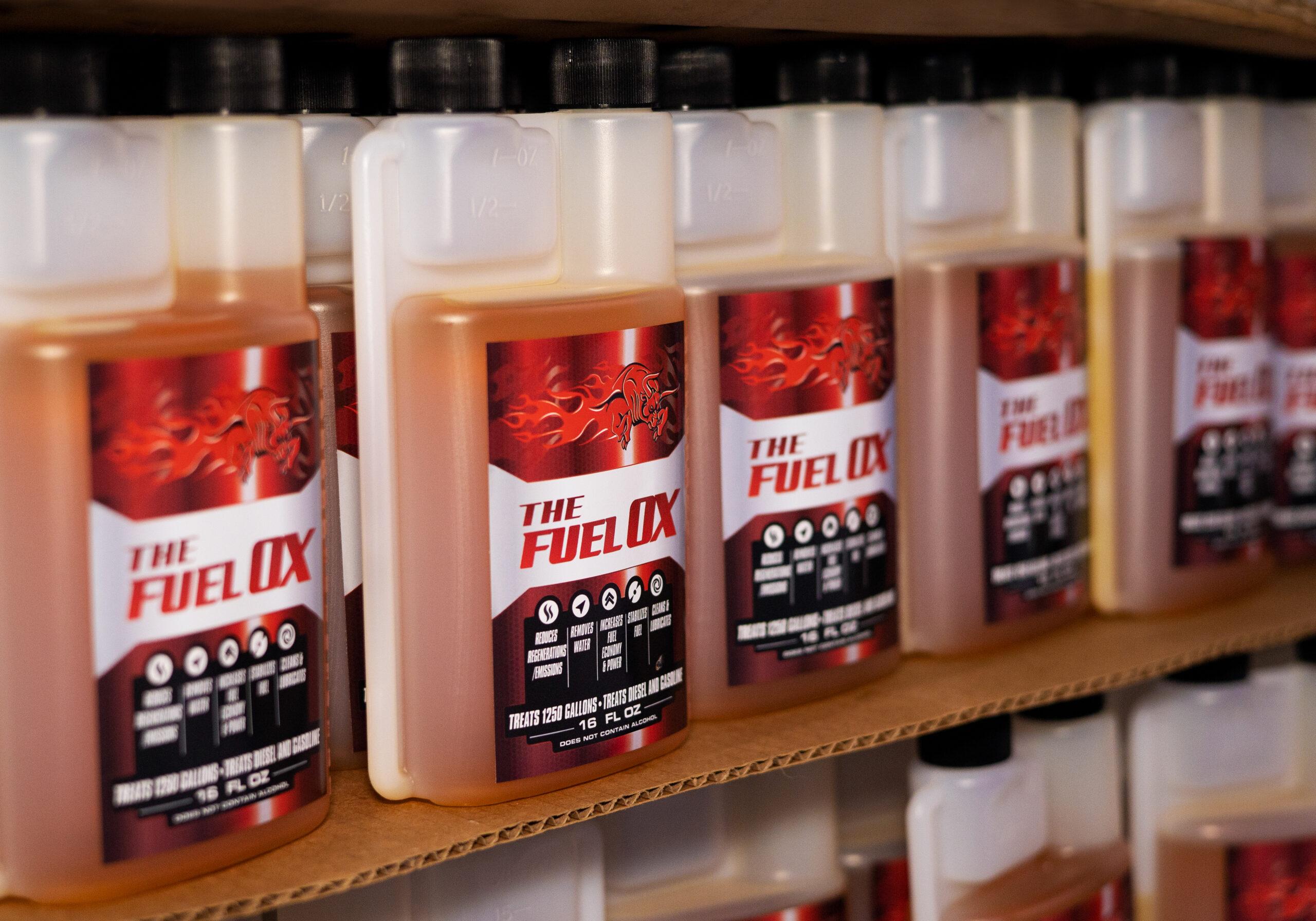
Multifunctional protection is exactly what Fuel Ox® with Combustion Catalyst was built to deliver.
A single treatment carries stabilizers to slow oxidation, detergents to keep metal surfaces free of deposits, an emulsifier that disperses water so it passes through instead of pooling, lubricity agents to replace what ULSD processing strips out, and a maintenance-level biocide to discourage microbial growth in tanks.
It is soluble in gas, diesel, and heavy fuel oil, and one gallon treats 10,000 gallons, so protecting a storage tank or an entire fleet costs little per gallon.
Protecting Your Fuel System Starts With the Right Additive
Corrosion follows a simple chain, and additives break it three ways: they control the water that makes the reaction possible, they reduce the corrosive chemistry that drives it, and they build a barrier between fuel and metal.
Done consistently, that protects fuel system components, supports engine performance, helps improve fuel efficiency and reduce emissions, and contributes to longer engine life.
What you need depends on your fuel and situation. Ethanol blends in older internal combustion engines, ultra-low sulfur diesel in high-pressure injection, biodiesel with microbial growth, and a generator tank holding fuel for a year are four different problems calling for different emphases within the same five mechanisms.
Identify your corrosion drivers, choose a formulation tested against them, dose it into fresh fuel at the right rate, and keep up the maintenance no additive can do for you.
If you have any questions about protecting your fuel system from corrosion, just contact us. We are happy to help.


